Mirror Type Selector
Recommendation
High ConfidenceVisual representation of curvature
Why this choice?
Explanation will appear here.
Installation Tips
Material & Maintenance Advice
Coating Recommendation
...
Glass Thickness
...
You’re standing in front of a store display or scrolling through online listings, staring at three identical-looking mirrors. One is flat, one curves outward like the back of a spoon, and one curves inward like a cave. You pick up the first one, then the second. The reflection in the second one makes your face look like you’ve been squished by a hydraulic press. Why does this happen? And more importantly, which one actually solves your problem?
Most people think all mirrors are the same until they hang one up and realize it distorts their height, shrinks their room, or creates weird blind spots. The truth is, the mirror is an optical device that reflects light to form images, categorized primarily by surface curvature into plane, convex, and concave types isn't just about glass and silver backing. It’s about geometry. Choosing the wrong shape can turn a functional hallway into a funhouse or make a small bathroom feel claustrophobic instead of spacious.
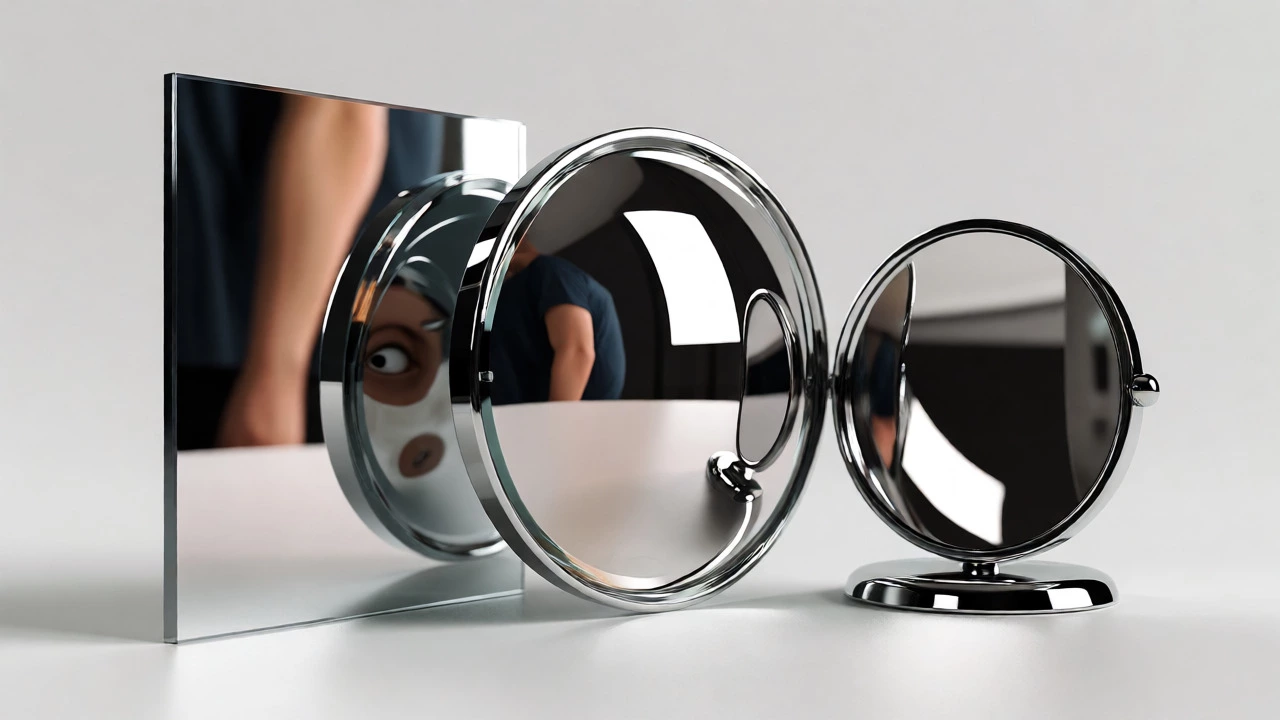
| Mirror Type | Surface Shape | Image Effect | Best Use Case |
|---|---|---|---|
| Plane (Flat) | Flat | True-to-size, reversed left-right | Bathrooms, dressing areas, general decor |
| Convex | Curves outward | Smaller image, wider field of view | Safety mirrors, tight corners, security |
| Concave | Curves inward | Magnified or inverted depending on distance | Makeup application, telescopes, headlights |
The Plane Mirror: Your Daily Workhorse
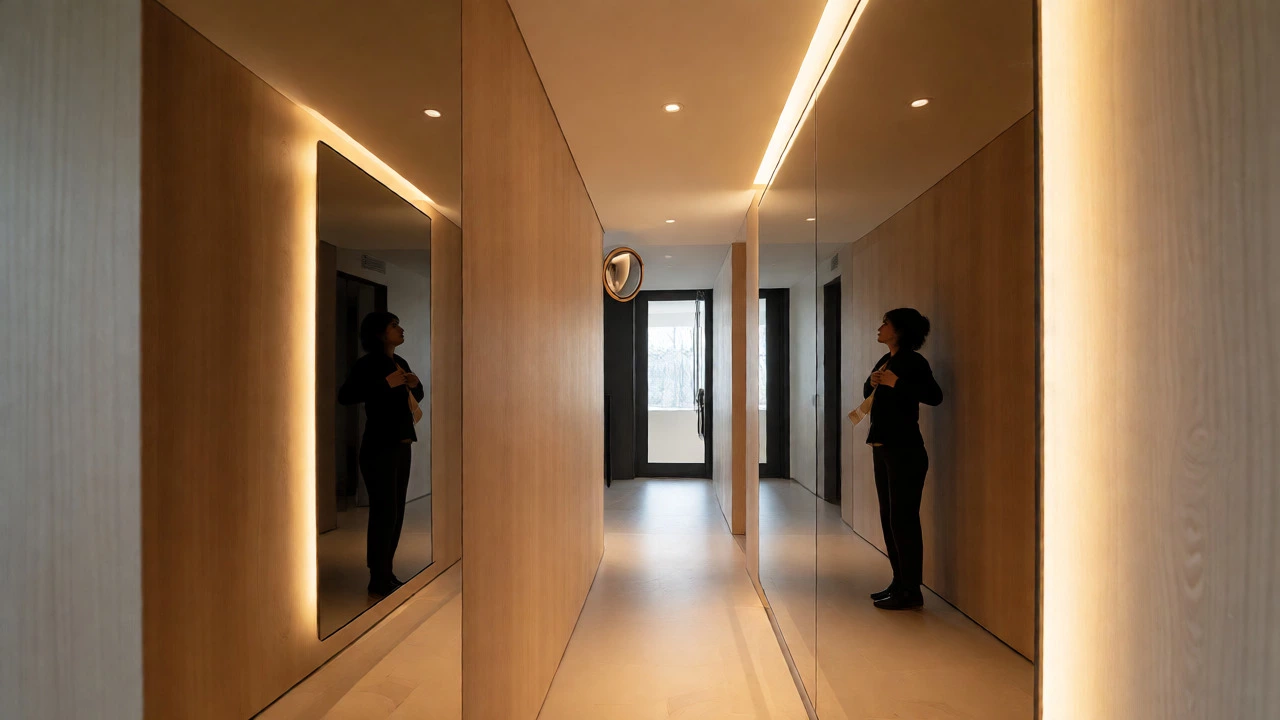
If you want to see what you actually look like, stick with a plane mirror. This is the standard flat glass you find in most bathrooms and bedrooms. It doesn’t distort proportions. If you’re six feet tall, the mirror shows you as six feet tall. There’s no trickery here.
Why do we default to these? Because accuracy matters when you’re getting dressed. You don’t want to buy a shirt that looks great in a distorted reflection but fits poorly in reality. Plane mirrors work best when placed vertically against a wall. They reflect light directly back, doubling the visual depth of a room without changing the scale of objects within it.
However, there’s a catch. Flat mirrors have a limited field of view. If you stand too close, you only see part of yourself. To see your full body, the mirror needs to be at least half your height and positioned correctly relative to your eye level. In narrow hallways, a large plane mirror might still leave blind spots because it only reflects what’s directly opposite it. It’s honest, but it’s not always comprehensive.
Convex Mirrors: Seeing More Than What’s There
Ever notice those round, bulging mirrors at the corner of a parking garage or inside a retail store? Those are convex mirrors, defined as curved surfaces that bulge outward toward the light source. Their superpower is compression. They squeeze a wide area into a smaller frame, letting you see around corners or monitor larger spaces.
This makes them ideal for safety. In Toronto, where I live, many older buildings have tight stairwells. Installing a small convex mirror at the landing helps prevent collisions because you can see someone coming from two directions at once. The trade-off? Everything looks smaller and farther away than it really is. That’s why road signs near convex mirrors often say "Objects in mirror are closer than they appear."
For home use, convex mirrors are rarely used for grooming. Who wants to look into a mirror that makes their nose look tiny and their ears huge? Instead, they serve practical purposes: security, traffic flow, and spatial awareness. If you have a long driveway or a blind corner in your living room layout, a convex mirror acts like a low-tech surveillance camera. It doesn’t record video, but it eliminates surprises.
Concave Mirrors: The Magnifying Glass
Then there’s the concave mirror, which curves inward like a bowl. These are the ones that can make you look like a giant if you get too close, or upside down if you step back. You’ve probably encountered these in makeup stations or dentist offices.
The physics here is fascinating but tricky. Concave mirrors converge light rays. If you stand very close (within the focal point), the image becomes upright and magnified. This is perfect for plucking eyebrows or applying eyeliner. But move just a few inches back, and suddenly your reflection flips upside down. It’s disorienting if you aren’t expecting it.
Because of this sensitivity to distance, concave mirrors require precise placement. They aren’t good for full-body checks. They excel at detail work. Some high-end bathroom setups include a dual-sided mirror: one side plane for overall appearance, one side concave for zoomed-in tasks. This hybrid approach solves the distortion issue while keeping the convenience of magnification nearby.
Material Matters: Silver vs. Aluminum Coatings
Once you decide on the shape, you need to worry about what’s behind the glass. Most modern mirrors use either aluminum or silver coatings. For years, silver was considered superior because it offered better color fidelity and durability against humidity. Aluminum is cheaper and easier to manufacture, which is why it dominates budget options.
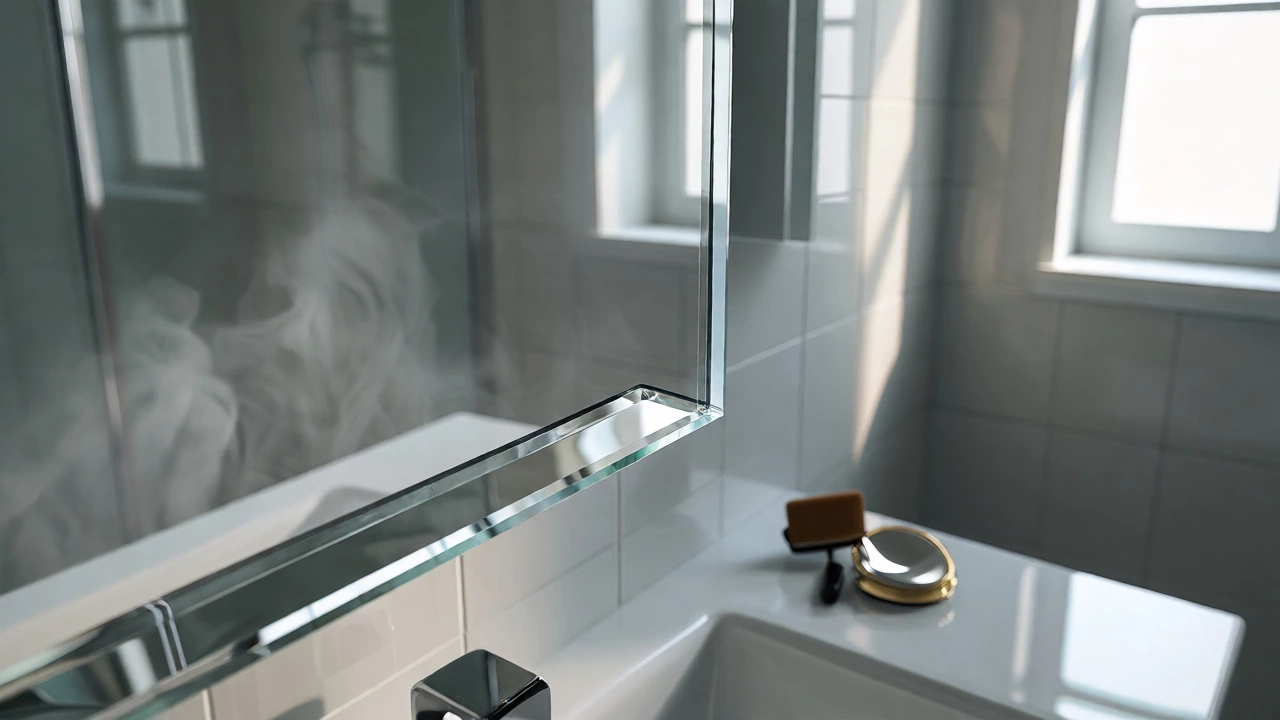
In humid environments like bathrooms, coating quality is critical. A cheap aluminum-backed mirror might start to blacken at the edges after a year of steam exposure. This "desilvering" ruins the aesthetic and reduces reflectivity. High-quality silver-coated mirrors resist this corrosion longer. If you’re installing a mirror in a shower-adjacent area, look for terms like "moisture-resistant backing" or "sealed edges." These features prevent water from seeping behind the glass and eating away at the reflective layer.
Glass thickness also plays a role. Thin glass (3mm) is prone to warping, which causes subtle distortions even in plane mirrors. Thicker glass (5mm or 6mm) stays rigid, ensuring a straight reflection. It’s heavier and more expensive, but for a primary vanity mirror, the clarity is worth the extra weight.
Framing and Installation: Beyond the Glass
The frame isn’t just decorative; it affects functionality. A heavy wooden frame adds warmth but blocks peripheral light. A frameless mirror maximizes surface area and feels modern, but it requires clean walls and precise mounting hardware. Without a frame, any imperfection in the wall shows up clearly in the reflection.
Lighting direction changes everything. Front-lit mirrors reduce shadows on your face, making them better for grooming. Backlit mirrors create ambient glow but can cast shadows under your chin. Side-lit setups offer balanced illumination. When choosing your mirror type, consider how light hits it. A concave mirror with poor lighting will highlight every pore and wrinkle, which might not be the vibe you want before heading out the door.
Placement height is another common mistake. Many people install bathroom mirrors too high. The center of the mirror should align with the average eye level of household users-usually around 57 to 60 inches from the floor. If it’s too high, you end up tilting your head back to see your forehead, which strains your neck. If it’s too low, you miss the top of your head. Measure twice, drill once.
Specialty Mirrors: Smart and Decorative Options
Tech has entered the mirror space. Smart mirrors integrate displays behind semi-transparent glass, showing weather, news, or calendar events while reflecting your image. These are essentially plane mirrors with embedded screens. They consume power and require Wi-Fi, but they add utility to otherwise passive surfaces.
Decorative mirrors, like sunburst designs or irregular shapes, fall under the plane category optically but serve artistic roles. They break up monotony in minimalist rooms. However, complex shapes can fragment reflections, creating multiple disjointed images rather than one cohesive view. Use these for accent pieces, not primary functional mirrors.
Antique mirrors often have slight waviness due to old manufacturing techniques. This "mercury glass" effect adds character but distorts straight lines. If you value precision, avoid vintage-style reproductions unless you accept the artistic distortion. Modern float glass is engineered for flatness, so new mirrors should provide crisp, undistorted images unless intentionally designed otherwise.
How to Choose: A Decision Framework
Still unsure? Run through this quick checklist:
- Do you need accurate size representation? Choose a plane mirror. Avoid convex or concave for fitting clothes.
- Do you need to see around corners or monitor a large area? Choose a convex mirror. Accept the reduced image size.
- Do you need magnification for detailed tasks? Choose a concave mirror, but ensure it’s mounted at the correct distance.
- Is humidity a concern? Prioritize sealed, silver-backed planes over open-frame aluminum options.
- Is space limited? Large plane mirrors visually expand rooms; convex mirrors physically fit tighter spots.
Remember, there is no single "best" mirror. There is only the best mirror for your specific task. A gym uses plane mirrors to check form. A shop uses convex mirrors for theft prevention. A surgeon uses concave mirrors for focus. Match the tool to the job, and you’ll never regret the purchase.
Why do some mirrors make me look fatter or thinner?
This is usually due to slight curvature in the glass or frame tension. Even "flat" mirrors can have minor convexity (making you look smaller/thinner) or concavity (making you look wider/fatter). High-quality thick glass minimizes this, but thin, cheap mirrors often warp slightly, causing unintended distortion.
Can I use a convex mirror in my bathroom?
You can, but it’s not recommended for grooming. Convex mirrors shrink images, so you won’t see true facial details or proportions accurately. They are better suited for safety purposes, such as seeing around a tight corner in a small powder room, rather than checking your outfit or makeup.
What is the difference between silver and aluminum mirrors?
Silver mirrors offer higher reflectivity and better resistance to corrosion, especially in humid environments like bathrooms. Aluminum mirrors are less expensive and lighter but may degrade faster when exposed to moisture, leading to black spots or edge deterioration over time.
How big should a full-length mirror be?
To see your entire body, the mirror must be at least half your height. Position the top edge of the mirror at eye level plus half the distance from your eyes to the top of your head. This geometric principle ensures you can see from head to toe without moving.
Are smart mirrors worth the cost?
They are worth it if you value integrated information like weather, calendars, or music controls in your morning routine. However, they rely on electronics that can fail, unlike passive glass mirrors. Consider them a luxury convenience rather than a necessity for basic reflection.