India Semiconductor Investment Calculator
Estimate the total capital required and government incentives for semiconductor projects in India based on current PLI schemes.
For decades, the narrative around Indian technology was simple: we write code, and the rest of the world builds the hardware. But if you look at the factory floors emerging across Tamil Nadu, Gujarat, and Karnataka today, that story is flipping. You might ask yourself, what is actually driving this shift? Is it just another government promise, or is there real momentum behind the scenes?
The answer lies in silicon. Specifically, semiconductor manufacturing. This is not just a buzzword; it is the fastest-growing technology sector in India right now. While software services have been the backbone of the IT economy for thirty years, the physical creation of microchips is exploding in scale. We are talking about billions of dollars in investment, massive land acquisitions, and a strategic pivot that places India squarely on the global electronics map.
Why is semiconductor manufacturing growing so fast in India?
The growth is driven by a combination of global supply chain diversification (China+1 strategy), massive government incentives through the Production Linked Incentive (PLI) scheme, and India's existing strength in design and engineering talent. Companies like Micron, Tata Electronics, and Bosch are setting up fabrication plants because the economic and geopolitical risks of relying solely on East Asia have become too high.
The Silicon Shift: From Design to Fabrication
To understand why this is happening now, you have to look at the difference between designing a chip and making one. For years, India was a powerhouse in chip design. Companies like Qualcomm, Intel, and AMD have huge R&D centers in Bangalore and Hyderabad. Engineers here designed processors used in billions of smartphones worldwide. But the actual fabrication-the dirty, expensive, water-intensive process of printing circuits onto silicon wafers-happened elsewhere.
That changed in 2021 when the Government of India launched the Production Linked Incentive (PLI) scheme for semiconductors. This wasn't a small grant. It offered financial incentives worth up to 50% of the capital expenditure for new projects. Why does this matter? Because building a semiconductor fab costs anywhere from $5 billion to $20 billion. Without that safety net, no private company would risk entering the market alone.
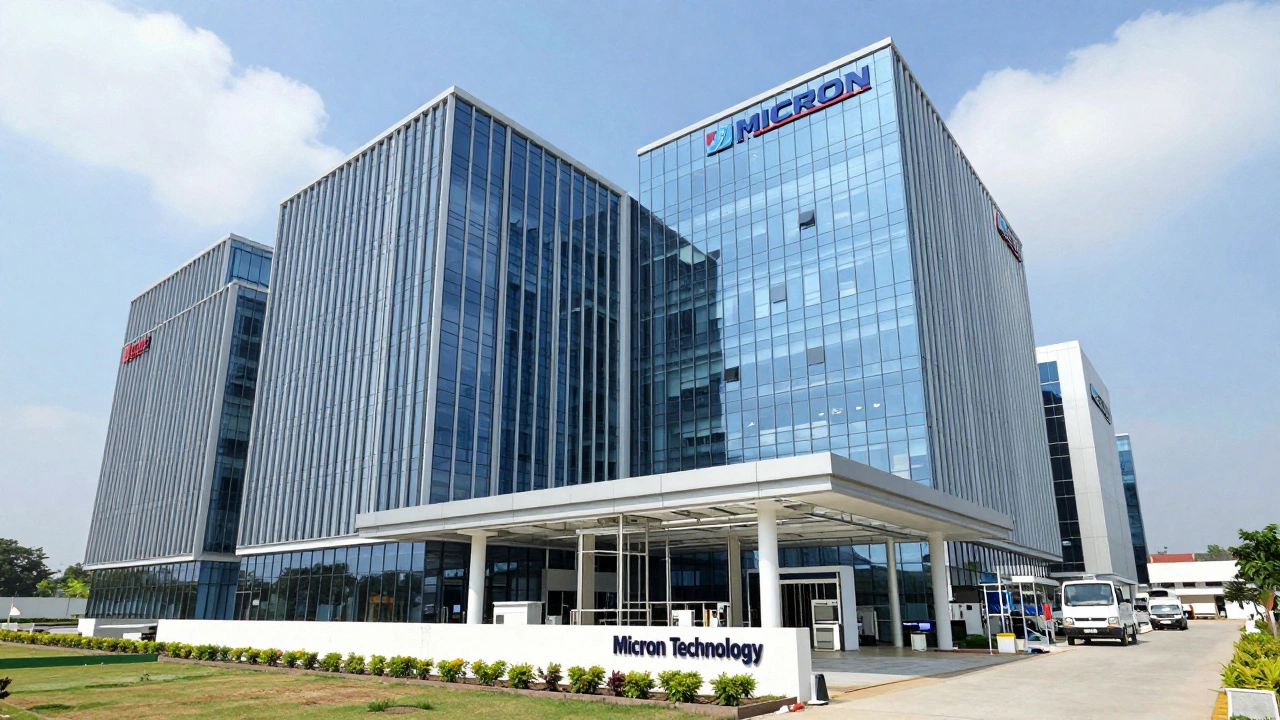
Let’s look at the numbers. By mid-2026, the Indian government has approved over $40 billion in semiconductor-related investments. The most visible player is Micron Technology, which broke ground on its first advanced packaging facility in Nandambakkam, Chennai. This isn't just assembly; it's high-tech packaging that determines how fast your phone or laptop runs. Then there is Tata Electronics, backed by the Tata Group, which is setting up a display module assembly plant in Dholera, Gujarat. These aren't pilot projects. They are industrial-scale operations meant to serve global markets.
Key Players Driving the Growth
Who is actually building these factories? It’s a mix of global giants and Indian conglomerates leveraging their local expertise. Here is a breakdown of the major entities shaping this landscape:
| Company | Type of Operation | Location | Investment Scale |
|---|---|---|---|
| Micron Technology | Advanced Packaging & Assembly | Chennai, Tamil Nadu | $1.7 Billion (Phase 1) |
| Tata Electronics | Display Module Assembly & Testing | Dholera, Gujarat | $1.2 Billion+ |
| Bosch | Semiconductor Fab (OSAT) | Nagpur, Maharashtra | $200 Million+ |
| CG Power & IdeMitsu | Power Semiconductor Modules | Haryana | $300 Million |
Notice something interesting? Most of these initial projects focus on Assembly, Testing, and Packaging (ATP) rather than front-end wafer fabrication. Why? Because ATP is less capital-intensive and easier to scale quickly. It’s the logical first step. Once the ecosystem matures-meaning you have reliable power, water treatment, and skilled technicians-the industry will move toward full-fledged fabrication. This phased approach reduces risk and allows India to prove its reliability as a manufacturing hub.
Infrastructure: The Hidden Challenge
You can’t build microchips without perfect conditions. A single speck of dust can ruin a batch of wafers. That means semiconductor plants need ultra-pure water, uninterrupted electricity, and specialized waste management. This is where the real test for India begins.
In the past, infrastructure gaps were a major deterrent. Frequent power outages or inconsistent water quality could halt production. However, recent developments show significant improvement. Special Economic Zones (SEZs) dedicated to electronics are being built with "plug-and-play" infrastructure. For example, the Dholera Smart City project in Gujarat is being developed specifically to house high-tech manufacturing units. It promises dedicated power grids and water recycling plants tailored for industrial use.
But let’s be honest-it’s still a work in progress. Water scarcity remains a critical issue, especially in western and southern states where many fabs are planned. Companies are investing heavily in closed-loop water systems, but regulatory hurdles and environmental concerns slow things down. If India wants to compete with Vietnam or Malaysia, it needs to solve these logistical puzzles efficiently. The speed of growth depends not just on money, but on whether the ground beneath the factories can support them.
The Talent Pipeline: Engineering vs. Skilled Labor
India produces more engineering graduates than any other country. So, isn’t labor the easy part? Not exactly. There is a mismatch between academic output and industry needs. Semiconductor manufacturing requires highly specialized technicians who understand cleanroom protocols, chemical handling, and precision machinery maintenance. These skills aren’t taught in standard engineering degrees.
To bridge this gap, the government and private sector are launching vocational training programs. Institutes like the Indian Institute of Technology (IIT) and National Institutes of Technology (NIT) are introducing courses in nanoelectronics and materials science. Meanwhile, companies like Micron are partnering with local polytechnics to create apprenticeship pipelines. The goal is to create a workforce that can operate multi-million-dollar machines with minimal error rates. This human capital development is just as crucial as the physical infrastructure.
Global Context: Why Now?
Why is the world turning to India for chips? The short answer is geopolitics. For years, the supply chain was concentrated in East Asia, particularly Taiwan and South Korea. Recent global disruptions highlighted the fragility of this model. Governments in the US, Europe, and Japan are actively encouraging companies to diversify. This is known as the "China+1" strategy.
India offers a unique proposition: a large domestic market of 1.4 billion people, English-speaking engineers, and political stability compared to some neighboring regions. When Apple shifts iPhone production to India, it doesn’t just bring assembly lines; it brings the entire ecosystem of component suppliers. Semiconductors are the next logical step in this value chain. As demand for electric vehicles, 5G networks, and AI servers grows, the need for chips will only increase. India is positioning itself to capture a slice of this booming global market.
Future Outlook: Beyond 2026
What does the future hold? If current trends continue, India could become a top-five global supplier of packaged semiconductors by 2030. The focus will likely expand beyond consumer electronics into automotive chips and industrial sensors. Electric vehicle manufacturers like Tata Motors and Mahindra are already integrating locally sourced components into their EV platforms.
However, challenges remain. Competition from Southeast Asia is fierce. Vietnam and Thailand are also offering attractive incentives. India must maintain its cost competitiveness while ensuring quality standards meet international benchmarks. Regulatory clarity is another factor. Investors need predictable policies, not sudden changes in tax laws or import duties.
Ultimately, the fastest-growing technology in India isn’t just about silicon. It’s about ambition. It’s about a nation deciding to stop importing its core technological dependencies and start creating them. Whether this transition succeeds fully depends on execution, patience, and sustained commitment from both the government and private sector. But one thing is clear: the era of India as merely a service provider is ending. The age of Indian-made hardware has begun.
Is India ready for full-scale semiconductor fabrication?
Not yet. Currently, India is focusing on backend processes like assembly, testing, and packaging (ATP). Full-scale front-end fabrication requires even higher levels of infrastructure maturity, including ultra-pure water sources and stable power grids. Experts predict that true fabrication capabilities may emerge by 2028-2030 as the ecosystem matures.
How does the PLI scheme help semiconductor companies?
The Production Linked Incentive (PLI) scheme provides cash incentives based on the value of products manufactured in India. For semiconductors, it covers up to 50% of capital expenditure for setting up facilities. This significantly reduces the financial risk for companies investing billions in new plants.
Which states are leading in semiconductor manufacturing?
Tamil Nadu, Gujarat, and Karnataka are currently the leaders. Tamil Nadu hosts Micron’s facility in Chennai. Gujarat is developing the Dholera Industrial Corridor for Tata Electronics. Karnataka, with its strong IT presence in Bangalore, is emerging as a hub for chip design and R&D.
What are the main challenges for India's semiconductor industry?
Key challenges include water scarcity, need for specialized skilled labor, high initial capital costs, and competition from established hubs like Vietnam and Malaysia. Additionally, maintaining consistent power supply and managing hazardous waste effectively are critical operational hurdles.
Will India replace China in electronics manufacturing?
Unlikely in the near term. China has a deeply entrenched supply chain and economies of scale that are hard to replicate. Instead, India is aiming to become an alternative hub, capturing a portion of the global market that seeks diversification away from China. It’s more about addition than replacement.

Mar 27 2025