Furniture Industry Dominance Calculator
Understand the Industry Structure
The Indian furniture industry consists of three main segments: manufacturing, retail, and artisan production. Select a segment to see which companies dominate and how they compare.
Key Players
Market Share Analysis
When you walk into a modern Indian home, the sofa you sit on, the dining table you eat at, or the bed you sleep in didn’t just appear out of nowhere. It was built-often by hand, sometimes by machine, and almost always by a company that’s been quietly shaping India’s furniture landscape for decades. But who actually runs this industry? Who holds the biggest market share, the most factories, and the deepest reach across cities and villages?
Indian furniture isn’t one industry-it’s many
Many people think of Indian furniture as a single block: wooden cabinets, carved beds, and plastic chairs. But that’s not accurate. The industry splits into three major segments: furniture manufacturing, retail distribution, and custom artisan production. Each has its own leaders.The manufacturing side is dominated by large-scale factories that produce ready-to-assemble (RTA) furniture using engineered wood, metal, and laminates. These companies supply not just homes, but offices, hotels, and government buildings. Then there’s the artisan side-small workshops in Moradabad, Ludhiana, and Jaipur that hand-carve teak and sheesham into traditional designs. And finally, the retail giants like Urban Ladder and Pepperfry, who don’t make furniture themselves but control how it reaches consumers.
The manufacturing giants: Godrej Interio and Durian
If you look at production volume, market coverage, and supply chain control, two names stand out: Godrej Interio is a subsidiary of the Godrej Group, founded in 1953, and operates over 12 manufacturing plants across India with annual revenues exceeding ₹1,800 crore. They make everything from modular kitchens to office cubicles. Their secret? Vertical integration. They control their own wood sourcing, foam production, and even packaging. That means they can scale fast and keep prices stable.Then there’s Durian is a Delhi-based manufacturer that went from a small workshop in 2008 to over 150 retail outlets today. They specialize in engineered wood furniture for urban apartments and produce more than 1.2 million units annually. Durian’s rise was built on affordability and design that fits small spaces-exactly what India’s growing middle class needed.
The retail disruptors: Pepperfry and Urban Ladder
You might not realize it, but companies like Pepperfry is an e-commerce platform that connects customers with over 1,200 furniture manufacturers across India. In 2025, they handled more than 4 million orders, making them the largest furniture marketplace by volume. They don’t own factories. Instead, they curate, market, and deliver. Their model works because they offer design tools, 3D room planners, and free delivery across 1,200+ cities.Urban Ladder was one of the first to push modern Scandinavian-style furniture into Indian homes. Though they were acquired by Pepperfry in 2021, their design language still influences how millions of Indians think about furniture today.
The hidden power: regional clusters
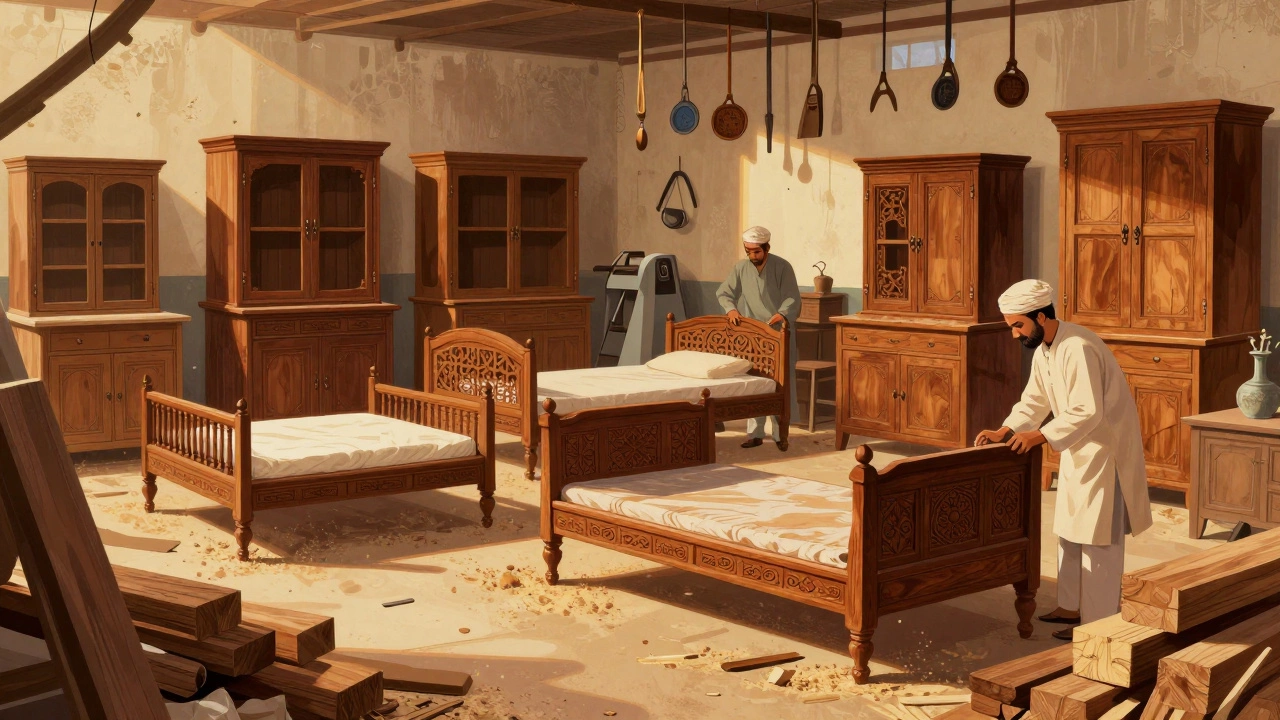
While big brands get the headlines, real production happens in clusters. In Uttar Pradesh, towns like Mirzapur and Badaun churn out 60% of India’s wooden furniture. In Punjab, Ludhiana’s factories pump out metal-framed beds and office chairs. Tamil Nadu leads in laminated and modular units for kitchens and wardrobes.These regions aren’t just locations-they’re ecosystems. In Mirzapur, entire families work in wood carving. In Ludhiana, welders and engineers collaborate with designers to build beds that fit narrow balconies. These clusters have low overhead, high labor efficiency, and deep supply chains. No national brand can match their cost structure.
Why Indian furniture is different
Most global furniture brands-IKEA, Ashley, or Wayfair-rely on standardized designs and global shipping. Indian manufacturers can’t do that. They have to adapt.For example, Indian homes are often smaller. So furniture must be multi-functional: a bed that turns into a sofa, a dining table that folds into a wall unit. Indian families also prefer solid wood over particleboard. And cultural preferences matter-many still want carved motifs, brass inlays, or deep red finishes.
This means Indian manufacturers can’t copy foreign models. They have to innovate locally. That’s why companies like Godrej Interio now have design teams based in Bangalore and Pune, studying how Indian families actually live-not how they’re shown in ads.

The rise of sustainability
In 2024, the Indian government launched the Make in India initiative for furniture, offering tax breaks to companies using FSC-certified wood and recycled materials. Since then, over 300 small manufacturers have switched to sustainable sourcing.Companies like Wooden Street is a brand that sources 100% FSC-certified wood and uses zero formaldehyde adhesives. They’ve grown 40% year-over-year since 2023, proving demand for eco-friendly furniture is real.
Even big players are adapting. Godrej Interio now uses 40% recycled wood in its product lines. Durian has cut packaging waste by 60% using reusable crates. Sustainability isn’t a buzzword here-it’s a survival tactic.
Who really dominates?
So who runs the Indian furniture industry? It’s not one company. It’s a mix.Godrej Interio leads in volume, reach, and vertical control. Durian leads in urban affordability and retail scale. Pepperfry controls the digital storefront. And behind them, thousands of small factories in Mirzapur, Ludhiana, and Coimbatore quietly produce the bulk of what’s sold.
The real power? It’s in the ecosystem. No single brand owns the whole chain. But together, they’ve built a system that’s faster, cheaper, and more adaptable than any Western competitor. India doesn’t dominate the global furniture market-yet. But inside its borders, no one else comes close.
Who is the largest furniture manufacturer in India?
Godrej Interio is the largest furniture manufacturer in India by production volume and revenue. With over 12 manufacturing plants and annual sales exceeding ₹1,800 crore, they supply furniture to homes, offices, and government institutions nationwide. Their vertical integration-controlling wood sourcing, foam, and packaging-gives them unmatched scale and cost control.
Are Indian furniture brands competitive globally?
Indian furniture brands aren’t yet major players in Europe or North America, but they’re gaining ground. Their advantage is cost efficiency, craftsmanship, and adaptability to local needs. Companies like Godrej Interio and Wooden Street are starting to export to the Middle East and Southeast Asia. The real strength lies in their ability to produce high-quality, custom-designed furniture at lower prices than Western competitors.
What materials are most commonly used in Indian furniture?
Engineered wood (MDF and particleboard) dominates urban furniture due to affordability and ease of mass production. Solid wood-especially sheesham and teak-is still preferred for traditional and high-end pieces. Metal frames are common in beds and office chairs, especially in northern states. Laminates and veneers are widely used for kitchens and modular units. Sustainability is pushing more brands toward FSC-certified wood and recycled materials.
How do small manufacturers survive against big brands?
Small manufacturers survive by specializing. Many focus on one product type-like carved wooden beds or metal-framed stools-and supply them to larger retailers or e-commerce platforms. They benefit from low labor costs, local material access, and decades-old craftsmanship. Platforms like Pepperfry and Urban Ladder now actively source from these small units, giving them national exposure without needing their own marketing budget.
Is handmade furniture still popular in India?
Yes, especially in rural areas and among buyers seeking heritage designs. Hand-carved sheesham furniture from Uttar Pradesh and brass-inlaid pieces from Rajasthan still command premium prices. Urban consumers are also rediscovering handmade pieces as a way to stand out from mass-produced furniture. Brands like Wooden Street and The White Company now market handmade collections as luxury items, often with price tags 30-50% higher than factory-made equivalents.