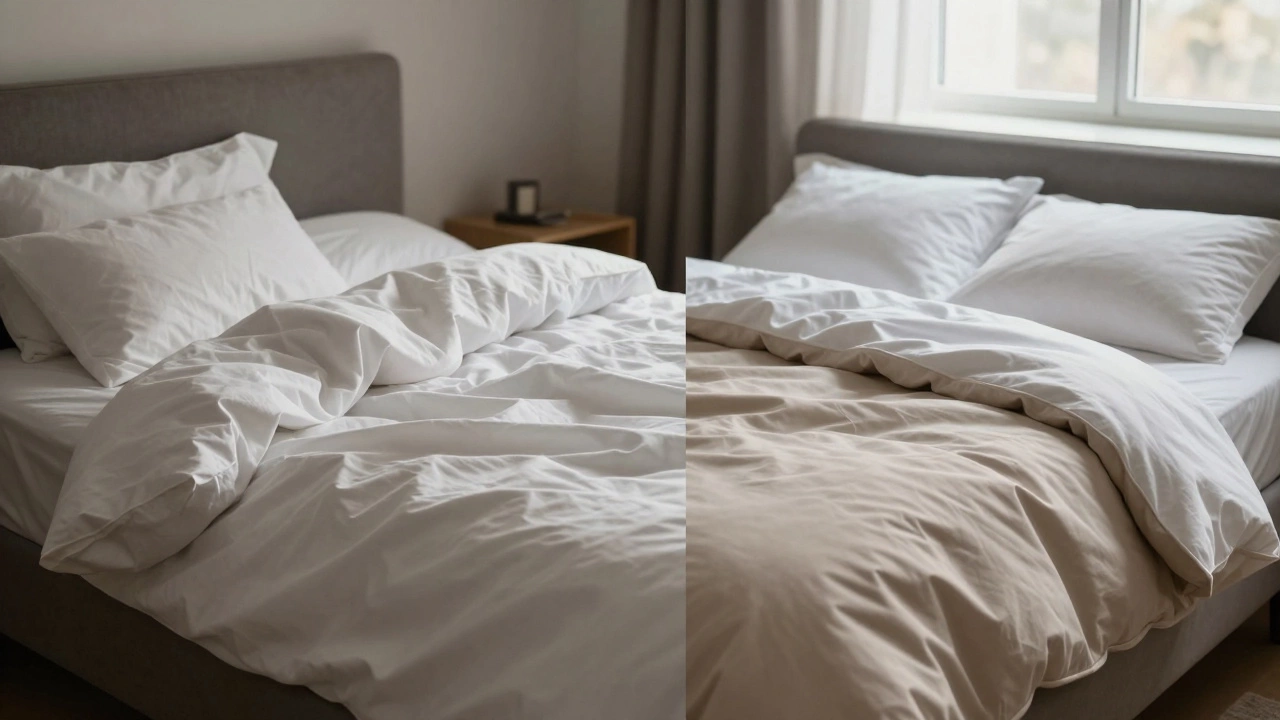
Bedding Battle: US vs. Europe Calculator
Your Sleep Habits
US Style
Top Sheet + Comforter
EU Style
Duvet Cover System
Why the Difference?
- Laundry: The US method involves washing a heavy comforter less often but struggling with dryer balance. The EU method washes lightweight covers frequently, which is faster and uses less energy.
- Tangles: Friction between the top sheet and comforter causes the "knot" effect. A single duvet layer moves with you, eliminating middle-layer friction.
- Space: Duvet inserts are fluffy but compressible. Storing multiple sheet sets + bulky comforters take up significantly more closet volume.
Ready to Compare?
Adjust your settings on the left to see how switching to a duvet might change your life.
You tuck yourself in tight with your top sheet, only to wake up at 3 AM tangled in a knot of cotton. Meanwhile, your friend from Berlin sleeps under a single, fluffy layer that stays put all night. It’s one of those cultural quirks that doesn’t make sense until you actually try it. If you’ve ever visited Europe and wondered why everyone just throws a big blanket over their pillowcases without that extra layer underneath, you’re not alone.
The short answer is convenience. But the real story involves laundry wars, heating costs, and a different philosophy about how we should spend our eight hours of sleep. Let’s break down why the top sheet has largely vanished across the Atlantic and whether you should ditch yours too.
The Anatomy of the Bed: US vs. Europe
To understand the difference, you have to look at what’s actually on the mattress. In North America, the standard bed setup is a layered cake. You start with a fitted sheet, then add a flat top sheet, followed by a comforter or duvet, and finally, multiple pillows. Each layer serves a specific purpose, but they also create friction-literally and figuratively.
In most of Europe, particularly in countries like Germany, France, and the Netherlands, the setup is simpler. They use a fitted sheet (or sometimes a flat sheet tucked tightly) and a duvet. That’s it. No middleman. The duvet acts as both the insulating layer and the decorative cover. Because the duvet is enclosed in a removable washable cover, there is no need for an additional sheet to protect it from sweat or body oils.
| Component | North American Style | European Style |
|---|---|---|
| Base Layer | Fitted Sheet | Fitted or Flat Sheet |
| Middle Layer | Flat Top Sheet | None |
| Insulation | Comforter or Duvet | Duvet Insert |
| Protective Cover | N/A (Comforter is washed whole) | Duvet Cover (Washed separately) |
| Pillow Protection | Pillowcase + Pillow Protector | Pillowcase Only |
The key distinction here is the Duvet Cover. A removable fabric case that encloses a duvet insert, designed to be washed regularly while protecting the filling. In the US, many people buy "comforters" which are pre-stuffed blankets meant to be thrown in the washing machine entirely. Washing a giant, heavy comforter is a nightmare; it takes forever to dry and can ruin your washer if it’s unbalanced. Europeans avoid this hassle by using lightweight covers that tumble-dry in 30 minutes.
The Laundry Factor: Why One Less Item Matters
Let’s talk about the chore nobody loves: laundry. In the US model, you have to wash the sheets, the pillowcases, and occasionally the comforter. If you use a top sheet, you are adding another item to the pile. When you strip the bed, you are juggling four to six separate pieces of fabric. Getting them back on the bed requires coordination. How many times have you tucked in the bottom sheet, placed the top sheet, added the duvet, and realized you forgot the pillowcases?
The European method reduces the cognitive load. You strip the bed: one set of sheets and one duvet cover. You wash them together. You put them back on. It’s faster, uses less detergent, and consumes less energy. For busy professionals or parents, saving twenty minutes a week on bed-making adds up over a year.
There is also the issue of space. Many apartments in cities like Paris, London, or Amsterdam are smaller than typical suburban homes in the US. Storage space for linens is premium. Keeping two sets of full bedding (sheets + duvet covers) takes up significantly less closet space than keeping two sets of sheets plus bulky comforters.
Temperature Control and Climate Adaptation
Culture is often shaped by environment, and bedding is no exception. Northern Europe experiences colder winters where central heating is essential but can be expensive. A duvet provides consistent insulation because it traps air evenly around your body. Unlike a quilt or a thin comforter that might slide off or bunch up, a properly weighted duvet stays in place.
In the summer, Europeans simply swap the thick winter duvet for a lighter "summer duvet" or just use the sheet. In the US, the top sheet is often marketed as a summer alternative to the heavy comforter. However, anyone who has tried to sleep under just a thin cotton sheet knows it offers little warmth and tends to cling to sweaty skin. A light linen duvet cover, by contrast, breathes better and maintains a more stable microclimate next to your body.
Furthermore, European buildings are often older and draftier. While modern renovations have improved insulation, the reliance on high-quality thermal bedding remains. The duvet system allows for precise temperature regulation based on the Tog rating (a measure of thermal resistance). You can buy a 4.5 Tog for summer, a 10.5 Tog for spring/autumn, and a 13.5 Tog for winter. This specificity eliminates the guesswork of "should I add a blanket tonight?" that comes with the layered American approach.
The Tangle Problem: Physics of Sleep
Here is the practical reality: layers move against each other. When you toss and turn, friction causes the top sheet to slide relative to the comforter. By morning, the top sheet is often bunched at your feet, leaving your legs exposed, or twisted into a pretzel around your torso. This disrupts sleep quality. Waking up cold because your sheet slipped off is a common complaint among top-sheet users.
With a duvet, there is only one surface touching your body (via the sheet underneath) and one surface covering you. There is no sliding between the middle layers because there are no middle layers. The duvet moves *with* you. If you kick it, it falls off entirely, which is an obvious signal to pull it back up. With a top sheet, you might not even realize it has shifted until you wake up shivering.
This isn't just anecdotal. Sleep studies suggest that minimizing physical disturbances during REM cycles improves restorative sleep. A static, comfortable sleeping environment contributes to this. The simplicity of the duvet system supports this stability.
Historical Context: Where Did the Top Sheet Come From?
The top sheet didn't appear out of nowhere. Its popularity in the US is largely tied to historical hygiene practices and manufacturing trends. Before synthetic fibers and easy-care fabrics, blankets were made of wool. Wool is warm but scratchy and heavy. People needed a soft barrier between their skin and the rough wool blanket. The cotton top sheet served this protective function.
Additionally, in the mid-20th century, washing machines were becoming common, but large-capacity dryers were not. Washing a heavy wool blanket was difficult and time-consuming to dry. A thin cotton sheet dried quickly. As quilts and comforters became mass-produced, the habit stuck. Even though modern materials have eliminated the need for a scratch-proof barrier, the tradition persisted through generational habit.
In Europe, the duvet (or "continental quilt") originated in Scandinavia. It was designed to be lightweight yet warm, utilizing down or synthetic fills that could be enclosed in a washable case. This innovation spread southward, becoming the standard because it solved the problem of washing bulky insulation without requiring a separate protective sheet.

Should You Switch? Pros and Cons
If you are considering making the switch to the European style, here is what you need to weigh.
Pros of Ditching the Top Sheet:
- Simplicity: Fewer items to wash, fold, and store.
- Comfort: No more tangled sheets or cold feet in the morning.
- Aesthetics: Duvet covers come in endless styles, allowing you to change the look of your bedroom easily without buying new sheets.
- Hygiene: You can wash the duvet cover weekly, ensuring fresh fabric against your skin every time.
Cons of Ditching the Top Sheet:
- Initial Cost: Buying a good quality duvet insert and several covers can be more expensive upfront than a simple sheet set.
- Learning Curve: Putting a duvet inside a cover can be frustrating if you don't use the right technique (like the "burrito method").
- Heat Sensitivity: If you run very hot, you might still prefer the airy feel of a single thin sheet over any duvet, even a light one.
How to Make the Transition
If you decide to give it a try, start small. You don’t need to throw away your current sheets. Buy a lightweight duvet insert and a matching cover. Try sleeping with just the fitted sheet and the duvet for a week. Pay attention to your temperature. Do you feel warmer? Cooler? More secure?
Invest in a duvet cover with corner ties or buttons. These features keep the insert from shifting inside the cover, mimicking the security of a tucked-in sheet. Choose natural fibers like cotton or linen for the cover, as they wick moisture better than polyester blends, addressing the hygiene concern that originally drove the top sheet trend.
Remember, bedding is personal. There is no "right" way to sleep, only the way that helps you rest best. But if you are tired of wrestling with your sheets every morning, the European approach might just be the upgrade your bedroom needs.
Do Europeans really never use top sheets?
While it varies by country and individual preference, the vast majority of households in Northern and Western Europe do not use top sheets. The duvet-and-cover system is the standard. In some Southern European countries, you might see more variation due to hotter climates, but the top sheet is generally considered unnecessary clutter.
Is it hygienic to sleep without a top sheet?
Yes, provided you wash your duvet cover regularly. The duvet cover serves the same purpose as a top sheet: it protects the inner filling from sweat, skin cells, and oils. Since duvet covers are typically thinner and easier to wash than comforters, many people find it easier to maintain hygiene with this system.
What is the difference between a duvet and a comforter?
A comforter is a finished bedding product with a decorative outer layer and filling sewn together; it is usually washed as a whole unit. A duvet is just the insert (the filling), which is meant to be placed inside a separate, removable duvet cover. The cover is what you wash, while the insert is cleaned infrequently.
Why do Americans use top sheets?
The tradition stems from historical needs to protect against scratchy wool blankets and to provide a breathable layer in humid climates. Over time, it became a cultural norm reinforced by hotel standards and retail marketing, even though modern materials have reduced the functional necessity.
Can I use my existing comforter with a duvet cover?
It depends on the size and thickness. Most standard duvet covers are designed for duvet inserts, which are often fluffier and slightly larger than comforters to allow for fill expansion. If your comforter fits snugly, it might work, but it could look wrinkled or tight. Check the dimensions carefully before attempting this swap.