Indian Chemical Sector Growth Calculator
Estimate the potential annual revenue growth for a chemical manufacturing facility in India by factoring in PLI incentives, cost savings from energy and labor, and domestic demand expansion.
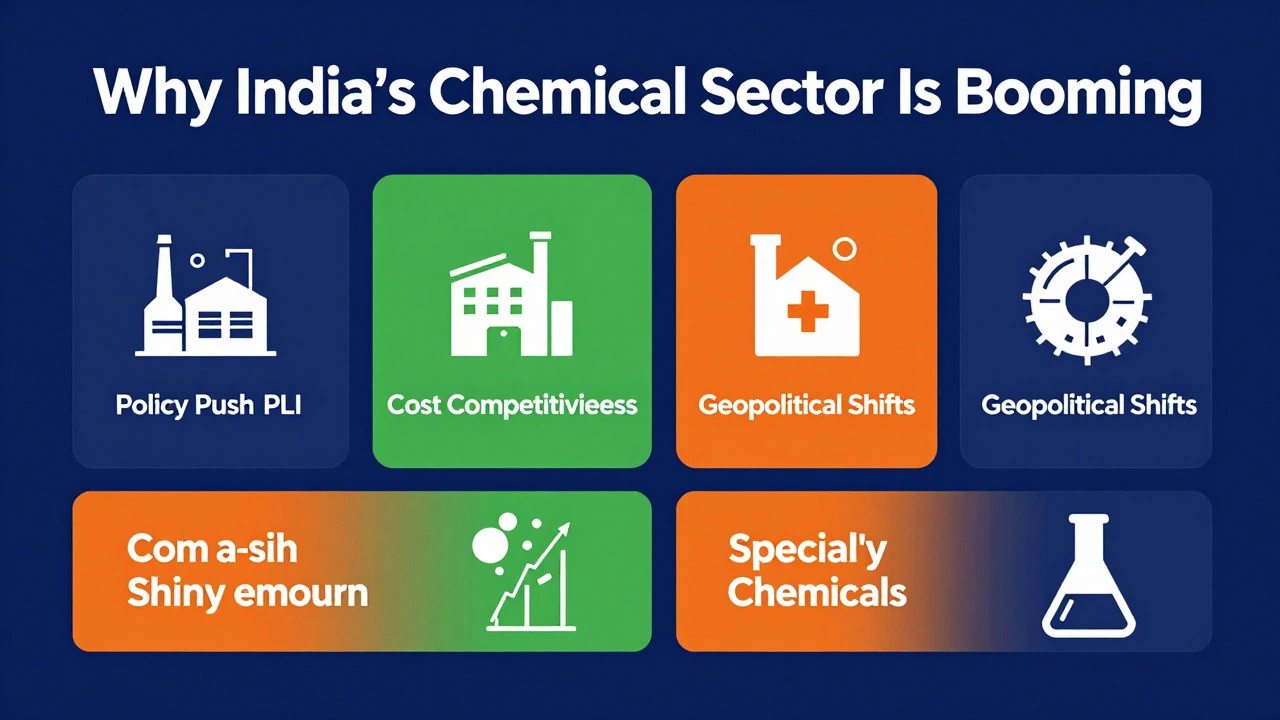
India is no longer just a source of cheap labor or generic bulk chemicals. It has become a powerhouse in the global chemical supply chain. If you look at the numbers, the growth is undeniable. The industry is projected to reach a massive valuation by 2030, driven by domestic demand and aggressive export strategies. But why is this happening right now? It isn't just one factor. It is a perfect storm of government policy, geopolitical shifts, and industrial maturity.
You might be wondering if this boom is sustainable or just a temporary spike. To understand where the money and jobs are flowing, we need to look under the hood of the Indian chemical sector, which is experiencing rapid expansion due to policy support, cost advantages, and shifting global supply chains. This article breaks down the real reasons behind this surge, what it means for investors and manufacturers, and where the opportunities lie in 2026 and beyond.
The Policy Push: Production Linked Incentive (PLI) Schemes
Let’s start with the biggest driver: government intervention. For years, Indian industries struggled with high costs and fragmented supply chains. That changed significantly with the introduction of the Production Linked Incentive (PLI) schemes. These are not just small subsidies; they are structural changes designed to make large-scale manufacturing profitable again.
The PLI scheme specifically targets key sectors like specialty chemicals, pharmaceuticals, and agrochemicals. By offering cash incentives based on incremental sales, the government encourages companies to scale up production locally rather than importing finished goods. This has led to a wave of new capacity additions. Major players are expanding existing plants, while new entrants are setting up greenfield projects. The result? A more robust, self-reliant ecosystem that reduces dependency on imports, particularly from China.
- Specialty Chemicals: High-value products get significant incentives to boost R&D and local production.
- Agrochemicals: Support for pesticides and fertilizers ensures food security and supports the agricultural backbone.
- Pharmaceutical Intermediates: Reducing reliance on foreign APIs (Active Pharmaceutical Ingredients) is a national priority.
This policy shift signals long-term stability. Investors see this as a green light. They know the government is committed to making India a global hub for chemical manufacturing. This confidence translates into foreign direct investment (FDI) and domestic capital allocation.
Cost Competitiveness and Infrastructure Improvements
Policy alone doesn’t build factories. You need infrastructure, energy, and labor. India checks all these boxes better than ever before. First, let’s talk about energy costs. Chemical manufacturing is energy-intensive. India has some of the lowest electricity tariffs in the world for industrial users, especially in states like Gujarat and Maharashtra. When your power bill is lower than your competitors’, your margins improve instantly.
Then there is the labor factor. While automation is increasing, skilled and semi-skilled labor remains abundant and affordable. The demographic dividend is real. Young workers are entering the workforce with better technical training thanks to initiatives like Skill India. This means higher productivity without the wage inflation seen in Western countries or even neighboring Asian nations.
Infrastructure has also taken a leap forward. The development of dedicated chemical corridors, improved port connectivity, and better logistics networks have reduced lead times. Ports like Mundra and Kandla have expanded their handling capabilities for hazardous and bulk chemicals. This makes exporting smoother and cheaper. Companies can move raw materials in and finished goods out efficiently, keeping the supply chain tight.
| Factor | Impact on Industry | Global Comparison |
|---|---|---|
| Energy Costs | Lower operational expenses | Among the lowest globally |
| Labor Availability | Scalable workforce with technical skills | More affordable than West/East Asia |
| Logistics & Ports | Faster export/import cycles | Improving rapidly with new infrastructure |
| Regulatory Support | Incentives via PLI schemes | Stronger than many emerging markets |
Geopolitical Shifts: The "China Plus One" Strategy
Here is where things get interesting. Global buyers are nervous. Over the past decade, China dominated the chemical supply chain. It was the go-to destination for everything from basic solvents to complex intermediates. But trade tensions, supply chain vulnerabilities exposed during the pandemic, and rising costs in China have forced multinational corporations to rethink their strategies.
This is known as the "China Plus One" approach. Companies keep some operations in China but diversify risk by adding a second supplier base elsewhere. India is the primary beneficiary of this shift. Why? Because it offers a similar scale of production, a common language (English), and a democratic legal framework that feels safer for Western investors compared to other alternatives.
We are seeing major European and American chemical giants set up joint ventures or acquire stakes in Indian firms. They want access to the Indian market and use India as an export hub to serve the rest of the world. This influx of technology and management expertise raises the overall quality standards of the Indian industry. It’s not just about volume anymore; it’s about precision and reliability.
Rise of Specialty Chemicals and Niche Markets
The old model was selling bulk commodities-cheap, low-margin, high-volume. The new model is different. The real growth story in India is in specialty chemicals, which are high-performance, application-specific chemicals used in electronics, automotive, and healthcare. These products command higher prices and better margins because they solve specific problems.
Think about the electric vehicle (EV) revolution. EV batteries need specialized electrolytes and separators. Solar panels require high-purity silicon and anti-reflective coatings. Semiconductors need ultra-pure gases and photoresists. India is positioning itself to capture this demand. Domestic automakers and electronics manufacturers are growing, creating a captive market for these specialty inputs.
Instead of importing these niche chemicals, Indian companies are investing in R&D to produce them locally. This moves the industry up the value chain. It’s no longer just about making soap or fertilizer; it’s about enabling advanced technologies. This shift attracts higher-quality investments and builds deeper expertise within the country.
Domestic Demand: A Growing Internal Market
Export growth is impressive, but don’t underestimate the power of the Indian consumer. As the middle class expands, so does the demand for chemicals across various sectors. Real estate construction is booming, driving demand for paints, adhesives, and waterproofing agents. The automotive sector is recovering strongly, needing lubricants, coatings, and plastics.
Agriculture remains a critical pillar. With a focus on food security, the demand for agrochemicals-pesticides, herbicides, and fertilizers-is steady and growing. Farmers are adopting modern techniques, which increases the usage of precision agriculture chemicals. Additionally, the personal care and cosmetics industry is exploding. Indians are spending more on skincare, haircare, and hygiene products, all of which rely on chemical formulations.
This internal demand provides a stable base for manufacturers. Even if global exports face headwinds, the domestic market can absorb a significant portion of the production. It creates resilience. Companies are no longer solely dependent on volatile international trade conditions.
Environmental Regulations and Green Chemistry
Growth often comes with environmental concerns. The chemical industry is traditionally seen as polluting. However, the current boom in India is being shaped by stricter environmental norms and a push towards sustainability. The government has tightened regulations on effluent treatment and waste disposal. This forces older, inefficient plants to upgrade or shut down, consolidating the market in favor of larger, compliant players.
At the same time, there is a rise in "green chemistry." Companies are investing in processes that reduce waste, use renewable energy, and create biodegradable products. This isn’t just about compliance; it’s about competitiveness. Global buyers increasingly prefer suppliers with strong Environmental, Social, and Governance (ESG) credentials. Indian firms that adopt green practices gain an edge in international tenders.
Renewable energy integration is another trend. Many chemical parks are now powered by solar or wind energy. This lowers carbon footprints and aligns with global net-zero goals. It shows that the Indian chemical sector is maturing, balancing growth with responsibility.
Challenges Ahead: What Could Slow Down the Boom?
It’s not all smooth sailing. There are hurdles. Regulatory delays can still plague project approvals. Land acquisition remains a sensitive issue in some states. Bureaucracy, though improving, can add friction. Investors need clarity and speed, and any lag here can deter capital.
Supply chain dependencies persist. While India is reducing reliance on China for final products, it still imports many raw materials and intermediates from there. Geopolitical tensions could disrupt these flows. Diversifying raw material sources is crucial for long-term stability.
Skill gaps also exist. While there is ample labor, finding highly specialized engineers and scientists for advanced R&D roles can be challenging. Educational institutions need to align curricula with industry needs faster. Bridging this gap will determine how quickly India can move into the highest tiers of chemical innovation.
Conclusion: The Road Forward
The boom in India’s chemical sector is not a fluke. It is built on solid foundations: supportive policies, cost advantages, geopolitical realignments, and rising domestic demand. The shift towards specialty chemicals and green manufacturing indicates a mature, evolving industry. For businesses, this presents a unique opportunity to partner, invest, or expand operations in a dynamic market.
As we move through 2026, watch for continued consolidation, increased FDI, and technological upgrades. The Indian chemical sector is poised to become a top-three global player. Whether you are a manufacturer, investor, or supplier, understanding these drivers is key to navigating this growth trajectory.
What are the main drivers behind the growth of the chemical sector in India?
The primary drivers include government incentives like the PLI scheme, lower energy and labor costs compared to global peers, the "China Plus One" strategy adopted by multinationals, and rising domestic demand from sectors like agriculture, automotive, and real estate.
How does the Production Linked Incentive (PLI) scheme help chemical manufacturers?
The PLI scheme provides cash incentives based on incremental sales of eligible products. This encourages companies to increase local production capacity, invest in technology, and reduce dependency on imports, thereby boosting profitability and competitiveness.
Is India replacing China as the global hub for chemicals?
India is becoming a major alternative, particularly for specialty chemicals and pharmaceutical intermediates. While it may not fully replace China immediately due to scale differences, it is capturing significant market share as global companies diversify their supply chains to mitigate risks.
What role do specialty chemicals play in India's chemical growth?
Specialty chemicals offer higher margins and are essential for advanced industries like EVs, electronics, and healthcare. India is focusing on producing these high-value products locally to meet both domestic demand and export requirements, moving up the value chain from bulk commodities.
What challenges does the Indian chemical sector face?
Key challenges include regulatory delays, land acquisition issues, dependence on imported raw materials (especially from China), and a shortage of highly specialized technical talent for advanced R&D roles.